MSC Nastran 2025 (v2025.1) Free
Introduction to MSC Nastran 2025
MSC Nastran 2025 (v2025.1) to predict how structures behave before they are manufactured. One of the most powerful tools used in this field is MSC Nastran 2025.
MSC Nastran is one of the world’s most trusted finite element analysis (FEA) solvers, used for structural, thermal, and dynamic simulations across many industries including aerospace, automotive, and manufacturing. Engineers use the software to simulate how products respond to loads, vibrations, heat, and other real-world conditions. The main goal is simple: identify potential design problems before building physical prototypes.
The 2025 release of MSC Nastran introduces improvements in solver performance, nonlinear analysis capabilities, and high-performance computing integration. These updates allow engineers to analyze larger and more complex models while reducing simulation time. With enhanced accuracy and performance, the software helps engineers create safer, lighter, and more efficient products.
Simulation tools like MSC Nastran play a crucial role in modern product development. Instead of building multiple prototypes, engineers can create virtual prototypes and test them digitally. This approach reduces development costs, accelerates innovation, and improves product reliability.
Overview of MSC Nastran 2025
MSC Nastran has a long and impressive history in engineering simulation. Originally developed by NASA in the 1960s, the software has evolved into one of the most widely used structural analysis solvers in the world. Over the years, it has become a standard tool in industries where reliability and accuracy are critical.
The 2025 version continues this legacy by introducing performance improvements and new solver technologies. Engineers can now analyze large and complex structures more efficiently thanks to improved parallel processing and optimized algorithms. According to Hexagon simulation updates, MSC Nastran remains one of the most reliable tools for multidisciplinary structural analysis, supporting static, dynamic, and thermal simulations within a single platform.
One of the most notable improvements in the latest release is the enhancement of nonlinear simulation capabilities. Nonlinear problems often occur in real engineering scenarios, such as material plasticity, large deformations, or contact interactions between components. The updated solver technology improves convergence and stability, allowing engineers to analyze these complex situations more accurately.
Another improvement is the integration of advanced numerical solvers that accelerate modal and dynamic analysis. These improvements allow engineers to solve models faster, even when working with millions of finite elements.
Core Capabilities of MSC Nastran
Linear and Nonlinear Structural Analysis
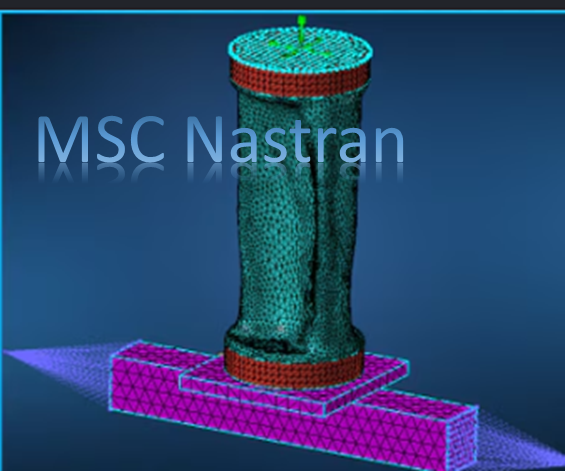
The primary function of MSC Nastran is structural analysis using the finite element method (FEM). This technique divides complex structures into small elements that can be analyzed mathematically. By applying loads, constraints, and material properties, engineers can predict how a structure will behave under real-world conditions.
MSC Nastran supports both linear and nonlinear analysis. Linear analysis assumes that structural behavior remains proportional to applied loads, which works well for small deformations and elastic materials. Nonlinear analysis, however, is required when structures experience large deformations, plastic behavior, or complex contact interactions.
The software can analyze a wide variety of structural problems including:
-
Static structural analysis
-
Buckling analysis
-
Dynamic vibration analysis
-
Nonlinear stress analysis
-
Contact and impact simulations
These capabilities allow engineers to evaluate structural integrity before manufacturing begins.
Thermal and Dynamic Simulation
In addition to structural analysis, MSC Nastran also supports thermal and dynamic simulations. Thermal analysis predicts how heat flows through a structure and how temperature changes affect materials. This is especially important in industries such as aerospace and electronics where thermal loads can significantly impact performance.
Dynamic analysis focuses on vibrations, shock loads, and time-dependent forces. For example, engineers may simulate how an aircraft wing responds to turbulence or how a car chassis reacts to road vibrations. The software can perform modal analysis, frequency response analysis, and transient dynamic simulations.
By combining structural, thermal, and dynamic analyses in a single platform, MSC Nastran provides a comprehensive solution for complex engineering challenges.
New Features in MSC Nastran 2025
Improved Nonlinear Solver Performance
One of the major improvements in MSC Nastran 2025 is the enhanced performance of the nonlinear solver used in SOL 400. Nonlinear simulations are often computationally expensive and difficult to converge, especially when dealing with complex contact interactions or material nonlinearities.https://scorpioagersoftware.com/
The new version introduces improvements in solver robustness and contact handling. Enhancements to the NLPERF nonlinear solver improve convergence and stability, allowing simulations to run more reliably. Engineers can now solve challenging problems that previously required extensive manual adjustments.
Additional improvements include better handling of rigid elements and constraints using advanced numerical methods. These updates reduce numerical conflicts between constraints and rigid body elements, improving overall simulation accuracy.
MUMPS Parallel Solver Integration
Another significant advancement in MSC Nastran 2025 is the integration of the MUMPS (Multifrontal Massively Parallel Sparse) solver for modal analysis and residual vector computations. This solver significantly accelerates calculations, particularly for models dominated by solid elements.
Studies have shown that this solver can deliver performance improvements exceeding 50% for certain simulation scenarios, especially in large-scale models.
The MUMPS solver also supports both symmetric and unsymmetric stiffness matrices, allowing engineers to analyze complex dynamic systems more efficiently. This enhancement makes MSC Nastran 2025 especially powerful for industries that rely on large-scale simulations such as aerospace and automotive engineering.
Advanced Engineering Analysis Tools
Fatigue Analysis
Many mechanical components fail not because of a single large load, but due to repeated loading cycles over time. This type of failure is known as fatigue. Predicting fatigue life is essential for designing reliable products such as aircraft structures, bridges, and automotive components.
MSC Nastran includes embedded fatigue analysis tools that allow engineers to evaluate how long a component will last under cyclic loading conditions. These tools analyze stress histories and estimate the number of cycles required for failure.
By predicting fatigue life during the design phase, engineers can make design changes that improve durability and safety.
Design Optimization
Another powerful feature of MSC Nastran is its automated design optimization capabilities. Optimization algorithms allow engineers to explore different design configurations automatically and find the best solution based on specific performance criteria.
For example, engineers may optimize a component to minimize weight while maintaining structural strength. The software can adjust variables such as material properties, geometric dimensions, and load conditions to find the optimal design.
MSC Nastran supports several optimization methods including:
-
Topology optimization – removing unnecessary material
-
Shape optimization – improving structural geometry
-
Topography optimization – optimizing sheet metal patterns
These tools help engineers create lightweight and efficient structures.
High Performance Computing in MSC Nastran
Engineering simulations can involve extremely large models with millions of finite elements. Solving such models requires significant computational resources.
MSC Nastran supports high-performance computing (HPC) technologies that allow simulations to run on multi-core processors and distributed computing clusters. The software uses advanced parallel processing methods such as:
-
Shared memory parallel computing
-
Distributed memory parallel computing
-
GPU acceleration for certain analyses
These capabilities enable engineers to solve large and complex models faster than ever before. HPC integration is especially important in industries where simulation accuracy and speed are critical.
Integration with MSC Apex and Patran
MSC Nastran is typically used together with pre- and post-processing tools such as MSC Apex and MSC Patran. These tools allow engineers to create geometry, generate finite element meshes, apply loads and boundary conditions, and visualize simulation results.
Recent updates have improved the integration between these tools. Engineers can now import models directly from Nastran H5 files, reducing workflow complexity and improving efficiency.
This integration creates a complete simulation environment where engineers can design, analyze, and optimize products within a single workflow.
Industries Using MSC Nastran
MSC Nastran is used in a wide range of industries where structural reliability is critical.
Aerospace
Aerospace engineers use MSC Nastran to analyze aircraft structures, satellites, and launch vehicles. The software helps ensure that these systems can withstand extreme loads, vibrations, and environmental conditions.
Automotive
Automotive companies rely on MSC Nastran for crash simulations, durability analysis, and noise-vibration-harshness (NVH) studies.
Manufacturing and Industrial Equipment
Manufacturers use the software to evaluate structural performance in heavy machinery, consumer products, and industrial systems.
Benefits of Using MSC Nastran 2025
MSC Nastran 2025 provides several important benefits for engineering teams:
-
Reduced physical prototyping costs through virtual testing
-
Improved product reliability through accurate structural analysis
-
Faster product development cycles
-
Better optimization of lightweight designs
Virtual prototyping allows engineers to detect potential structural issues early in the design process, reducing costly redesigns and delays.
MSC Nastran 2025 vs Previous Versions
| Feature | Previous Versions | MSC Nastran 2025 |
|---|---|---|
| Nonlinear Solver | Standard convergence | Improved NLPERF solver |
| Parallel Processing | Limited scalability | Enhanced HPC performance |
| Modal Solver | Traditional methods | MUMPS parallel solver |
| Workflow Integration | Standard integration | Improved Apex integration |
| Simulation Speed | Moderate | Faster and more stable |
These improvements make the 2025 version more powerful and efficient for complex engineering simulations.
Conclusion
MSC Nastran 2025 continues to be one of the most powerful and reliable finite element analysis solvers available today. With improved nonlinear solver performance, advanced parallel computing capabilities, and enhanced integration with modern CAE tools, the software enables engineers to analyze complex structures with greater accuracy and efficiency.
For industries where safety, reliability, and performance are critical, simulation tools like MSC Nastran are essential. By enabling virtual testing and automated optimization, the software helps engineers design better products while reducing development costs and time.
Whether used in aerospace engineering, automotive design, or industrial manufacturing, MSC Nastran 2025 remains a cornerstone of modern engineering simulation.
FAQs
1. What is MSC Nastran used for?
MSC Nastran is a finite element analysis (FEA) software used to simulate structural, thermal, and dynamic behavior of engineering components.
2. Who developed MSC Nastran?
MSC Nastran was originally developed by NASA and later commercialized by MSC Software, now part of Hexagon.
3. What industries use MSC Nastran?
Industries such as aerospace, automotive, defense, manufacturing, and energy use MSC Nastran for structural analysis.
4. What is new in MSC Nastran 2025?
The 2025 version includes improved nonlinear solvers, faster parallel processing, MUMPS solver integration, and enhanced workflow integration.
5. Is MSC Nastran difficult to learn?
MSC Nastran has a steep learning curve, but with training and modern CAE interfaces like MSC Apex, engineers can learn it effectively.
Autodesk Moldflow 2025 Free Download With New Update Version
MSC Nastran 2025 (v2025.1) Free