ANSYS Mechanical 2025 R1 Free Download
ANSYS Mechanical 2025 R1, introduces new capabilities and performance improvements designed to help engineers solve complex structural problems faster and more accurately. With advanced finite element analysis (FEA), enhanced solver technologies, and improved usability, this version offers significant benefits for engineers working in aerospace, automotive, electronics, construction, and many other industries.
This article provides a detailed overview of ANSYS Mechanical 2025 R1, including its features, capabilities, applications, advantages, and system requirements.
What is ANSYS Mechanical?
ANSYS Mechanical is a powerful engineering simulation tool used for structural analysis. It allows engineers to analyze how mechanical components behave under different conditions such as forces, pressure, temperature, vibration, and deformation.
The software is based on the Finite Element Analysis (FEA) method, which divides complex structures into smaller elements and calculates how each element behaves under various loads.
By using ANSYS Mechanical, engineers can predict:
-
Stress distribution
-
Structural deformation
-
Fatigue life
-
Vibration behavior
-
Thermal expansion
-
Failure points
This enables companies to optimize designs before manufacturing, saving time and cost.

Overview of ANSYS Mechanical 2025 R1
ANSYS Mechanical 2025 R1 is designed to improve simulation speed, accuracy, and user experience. It includes several enhancements in solver technology, modeling capabilities, and post-processing tools.
The main objectives of this release include:
-
Faster simulation performance
-
Improved model preparation tools
-
Enhanced nonlinear analysis capabilities
-
Better automation and workflow efficiency
-
Improved visualization and results analysis
These improvements help engineers analyze more complex models with greater confidence.
User Interface and Workflow Improvements
One of the most noticeable improvements in ANSYS Mechanical 2025 R1 is the enhanced user interface.
Modern Workspace
The updated interface provides a cleaner and more organized workspace that helps users focus on the simulation process.
Improved Navigation
Engineers can now navigate complex models more easily with improved graphics and interactive controls.
Workflow Automation
The software includes new automation tools that simplify repetitive tasks such as mesh generation and boundary condition setup.
Faster Project Management
Projects can be managed more efficiently with improved data handling and faster loading times.
These improvements make the software more accessible for both beginners and experienced analysts.
Geometry and Model Preparation
Before running simulations, engineers must prepare the geometry and define the physical properties of the model.
ANSYS Mechanical 2025 R1 includes improved tools for geometry preparation.
Geometry Import
The software supports many CAD formats, including:
-
STEP
-
IGES
-
Parasolid
-
SolidWorks
-
CATIA
-
NX
This ensures seamless integration with various CAD systems.
Geometry Cleanup
New tools help engineers remove unnecessary features such as small holes or fillets that could complicate the mesh.
Benefits include:
-
Faster simulation setup
-
Reduced computational time
-
Improved solver stability
Advanced Meshing Technology
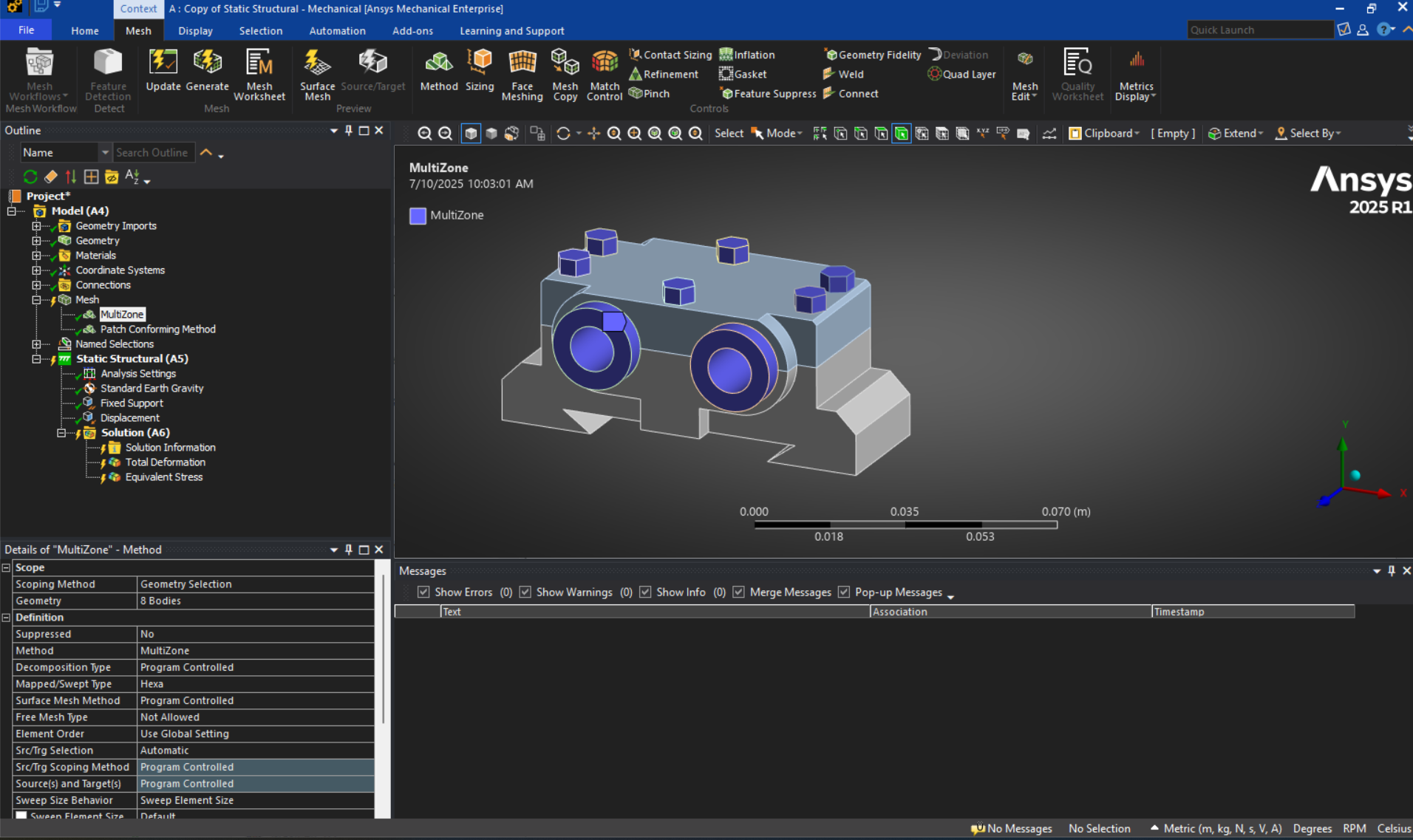
Meshing is one of the most important steps in simulation. The mesh divides the model into small elements used in numerical calculations.
ANSYS Mechanical 2025 R1 includes improved meshing capabilities.
Automatic Mesh Generation
The software can automatically generate high-quality meshes based on geometry and analysis requirements.
Adaptive Meshing
Adaptive mesh refinement automatically improves mesh quality in areas with high stress or complex geometry.
High-Quality Elements
The software supports various element types, including:
-
Tetrahedral elements
-
Hexahedral elements
-
Shell elements
-
Beam elements
These options allow engineers to choose the most suitable mesh type for their simulations.
Linear Structural Analysis
Linear structural analysis is one of the most common types of simulations performed in ANSYS Mechanical.
This analysis assumes that material behavior is linear and deformations are small.
Capabilities
Engineers can simulate:
-
Static loads
-
Structural stress
-
Displacement
-
Reaction forces
Typical applications include:
-
Machine components
-
Structural frames
-
Mechanical assemblies
The improved solver in ANSYS Mechanical 2025 R1 allows these simulations to run faster and with greater accuracy.
Nonlinear Structural Analysis
Many real-world engineering problems involve nonlinear behavior.
ANSYS Mechanical 2025 R1 includes advanced nonlinear analysis capabilities.
Types of Nonlinearity

-
Material Nonlinearity
Occurs when materials do not follow linear stress-strain relationships.
Examples include:
-
Plastic deformation
-
Hyperelastic materials
-
Rubber components
-
Geometric Nonlinearity
Occurs when large deformations change the structure’s geometry.
-
Contact Nonlinearity
Occurs when multiple parts interact or collide.
Examples include:
-
Bolted connections
-
Gear interactions
-
Mechanical assemblies
The improved nonlinear solver helps engineers analyze complex problems with greater stability.
Thermal-Structural Coupling
Many engineering systems involve both mechanical and thermal effects.
ANSYS Mechanical 2025 R1 allows engineers to perform coupled thermal-structural analysis.
Thermal Effects
Engineers can simulate:
-
Thermal expansion
-
Temperature-induced stress
-
Heat transfer effects
Applications
Examples include:
-
Electronic components
-
Engines and turbines
-
Heat exchangers
These simulations help engineers understand how temperature changes affect structural performance.
Fatigue Analysis
Fatigue is a common cause of failure in mechanical components.
ANSYS Mechanical 2025 R1 includes advanced fatigue analysis tools that help engineers predict the lifespan of parts subjected to repeated loading.
Fatigue Evaluation Methods
-
Stress-life method
-
Strain-life method
-
Crack growth analysis
Benefits
Fatigue analysis helps engineers:
-
Identify potential failure points
-
Improve product durability
-
Extend product life cycles
Dynamic Analysis
Dynamic analysis studies how structures behave under time-dependent loads.
ANSYS Mechanical 2025 R1 supports several dynamic simulation methods.
Modal Analysis
Modal analysis determines natural frequencies and mode shapes of structures.
Harmonic Analysis
Used to analyze structures subjected to sinusoidal loads.
Transient Structural Analysis
Simulates the response of structures to time-varying loads.
These analyses are essential in industries such as automotive and aerospace.
Contact and Assembly Simulation
Many engineering systems consist of multiple interacting parts.
ANSYS Mechanical 2025 R1 includes advanced contact modeling capabilities.
Contact Types
The software supports different contact behaviors such as:
-
Frictional contact
-
Bonded contact
-
Sliding contact
-
Separation contact
Improved Contact Algorithms
The latest version includes improved algorithms that enhance convergence and accuracy.
This is especially important for complex assemblies.
Solver Performance Improvements
One of the major highlights of ANSYS Mechanical 2025 R1 is improved solver performance.
Faster Calculations
New solver optimizations reduce computation time.
Parallel Processing
The software uses multi-core processors to accelerate simulations.
High-Performance Computing
ANSYS Mechanical can utilize high-performance computing (HPC) environments for large simulations.
These improvements allow engineers to simulate larger and more complex models.
Post-Processing and Visualization
After completing a simulation, engineers analyze the results to understand system behavior.
ANSYS Mechanical 2025 R1 includes advanced post-processing tools.
Visualization Tools
Users can visualize:
-
Stress distribution
-
Deformation patterns
-
Temperature fields
-
Safety factors
Animation Features
Simulation results can be animated to show how structures deform under load.
Custom Reports
Engineers can generate professional reports containing images, graphs, and analysis results.
Automation and Scripting
Automation is an important feature for improving engineering workflows.
ANSYS Mechanical supports scripting using Python.
Benefits of Automation
-
Automate repetitive tasks
-
Run batch simulations
-
Customize workflows
-
Integrate with external tools
Automation is especially useful for large-scale engineering projects.
Applications of ANSYS Mechanical 2025 R1
ANSYS Mechanical is used in many industries.
Aerospace Industry
Engineers use it to analyze aircraft structures, wings, landing gear, and turbine components.
Automotive Industry
Automotive companies use simulation to design safer and more efficient vehicles.
Electronics Industry
Thermal and structural simulations help prevent overheating and mechanical failure in electronic devices.
Energy Sector
ANSYS Mechanical is used to analyze turbines, pipelines, and power plant components.
Construction and Civil Engineering
Structural engineers use the software to evaluate buildings, bridges, and infrastructure projects.
System Requirements
To run ANSYS Mechanical 2025 R1 efficiently, the following system requirements are recommended.
| Component | Recommended Specification |
|---|---|
| Operating System | Windows 10 / Windows 11 |
| Processor | Intel Core i7 / AMD Ryzen |
| RAM | 32 GB or higher |
| Graphics Card | Professional GPU (NVIDIA Quadro or equivalent) |
| Storage | SSD with 50 GB free space |
| Display | 1920×1080 or higher |
High-performance systems are recommended for large simulations.
Advantages of ANSYS Mechanical 2025 R1
High Accuracy
The advanced FEA solver provides highly accurate results for complex engineering problems.
Wide Range of Analysis Types
The software supports linear, nonlinear, thermal, fatigue, and dynamic analyses.
Industry Standard Tool
ANSYS Mechanical is widely used by major engineering companies around the world.
Integration with ANSYS Ecosystem
It integrates seamlessly with other ANSYS products such as CFD and electromagnetic simulation tools.
Powerful Visualization
Advanced post-processing tools help engineers understand simulation results easily.
Limitations
Despite its many advantages, ANSYS Mechanical also has some limitations.
High Hardware Requirements
Large simulations require powerful computers.
Complex Learning Curve
New users may need training to fully utilize the software.
Cost
Professional simulation software can be expensive for small businesses.
Conclusion
ANSYS Mechanical 2025 R1 represents a significant advancement in structural simulation technology. With improved solver performance, enhanced modeling tools, better nonlinear analysis capabilities, and advanced visualization features, the software enables engineers to analyze complex structures with greater accuracy and efficiency.
By using ANSYS Mechanical, companies can reduce development costs, minimize physical testing, and accelerate product innovation. From aerospace and automotive engineering to electronics and energy systems, the software plays a vital role in modern engineering design and analysis.
As engineering challenges continue to grow in complexity, tools like ANSYS Mechanical 2025 R1 will remain essential for developing safer, stronger, and more efficient products.
BobCAD-CAM V37 Free Download 2026 New Updates
ANSYS Mechanical 2025 R1 Free Download