Altair HyperWorks 2025 (v2025.0): The Ultimate Engineering Simulation and Design Platform
Introduction to Altair HyperWorks 2025
Engineering has entered a new era where products can be designed, tested, and optimized virtually before they ever exist in the physical world. At the heart of this transformation is Altair HyperWorks 2025 (v2025.0), a powerful design and simulation platform used by engineers, researchers, and manufacturers across the globe. This software suite brings together artificial intelligence, high-performance computing, and multiphysics simulation to help organizations build smarter products faster than ever before.
The release of HyperWorks 2025 marks a significant step forward in digital engineering. The platform aims to support what industry experts call a “zero-prototype world,” where engineers perfect designs virtually before building physical prototypes. By combining advanced modeling tools, simulation solvers, and optimization technologies into one environment, HyperWorks enables companies to reduce development costs while improving product performance.
What is Altair HyperWorks?
Altair HyperWorks is a comprehensive CAE (Computer-Aided Engineering) platform that allows engineers to simulate, analyze, and optimize product designs. Instead of relying on expensive physical prototypes, engineers can use HyperWorks to test designs digitally under various conditions such as stress, heat, vibration, and airflow.
Think of it like a virtual laboratory for engineering innovation. Instead of building ten physical models to test different scenarios, engineers can simulate thousands of variations within the software. The result is faster innovation, reduced manufacturing costs, and more reliable products.
HyperWorks integrates numerous specialized tools such as:
-
HyperMesh – advanced finite element meshing
-
OptiStruct – structural analysis and optimization
-
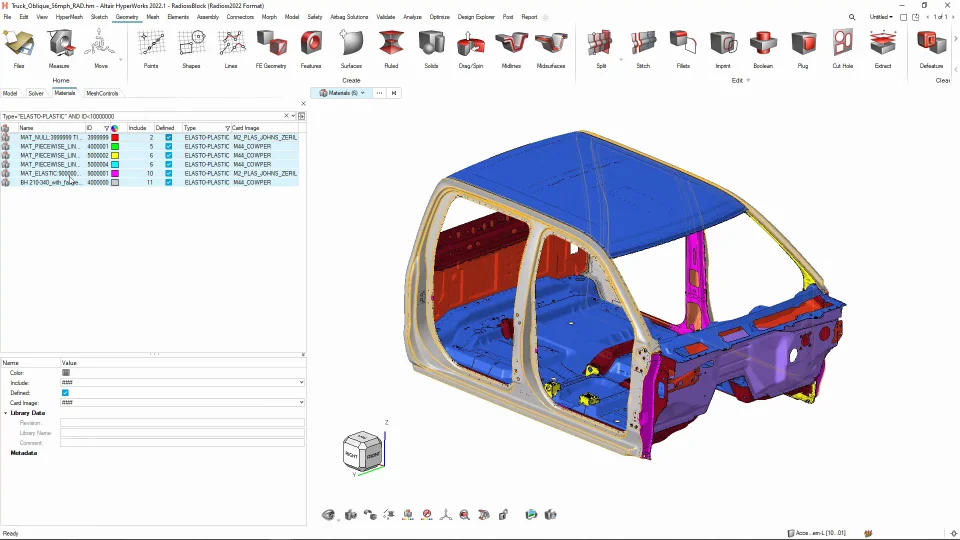
Radioss – crash and impact simulation
-
HyperStudy – design exploration and optimization
-
HyperView – simulation result visualization
This integrated ecosystem gives engineers the ability to solve extremely complex engineering problems across multiple disciplines.
Evolution of HyperWorks to Version 2025
HyperWorks has been evolving for decades, and each new release introduces major improvements in performance, usability, and simulation capabilities. The 2025 version builds upon more than 40 years of Altair’s expertise in simulation and design optimization.
Earlier versions of HyperWorks focused mainly on structural analysis and finite element modeling. However, modern engineering challenges require a much broader approach. Products today combine electronics, software, materials science, and mechanical engineering. HyperWorks 2025 addresses this complexity by offering multiphysics simulation, AI-driven analysis, and cloud-based computing capabilities.
Another major shift in this version is the integration of machine learning into engineering workflows. Traditional simulation methods often require extensive computation time and large datasets. HyperWorks 2025 introduces AI-based prediction models that can simulate results faster and with fewer resources. This allows engineers to explore design possibilities much earlier in the development process.
Key Features of Altair HyperWorks 2025
HyperWorks 2025 introduces several innovative features that push the boundaries of digital engineering. The platform blends AI technologies with high-performance computing to provide faster, more accurate simulations.
AI-Powered Engineering and Simulation
One of the most exciting aspects of HyperWorks 2025 is the integration of AI-driven engineering tools. Artificial intelligence is no longer limited to data science applications; it now plays a key role in engineering simulation.
The software uses machine learning models and transformer-based physics prediction algorithms to analyze complex systems. These models can predict physical behavior even when engineers have limited experimental data.
AI capabilities in HyperWorks include:
-
AI-based simulation solvers
-
Reduced Order Modeling (ROM)
-
Machine learning-assisted optimization
-
Predictive physics modeling
Reduced Order Modeling is particularly powerful because it enables engineers to simulate nonlinear systems faster than traditional methods. Instead of calculating every detail of a model, ROM focuses on the most important variables, significantly reducing computation time.
The result? Engineers can perform simulations that once took hours or days in just minutes.
High-Performance Computing (HPC) Integration
Simulation often requires enormous computing power. HyperWorks 2025 leverages high-performance computing (HPC) to handle extremely complex models and large datasets.
HPC allows simulations to run in parallel across multiple processors or cloud systems. This dramatically speeds up engineering workflows, enabling engineers to run thousands of design variations simultaneously.
The combination of AI and HPC makes HyperWorks one of the most advanced engineering platforms available today. Engineers can now analyze complex systems such as aircraft structures, electric vehicle batteries, and semiconductor devices with unprecedented speed and accuracy.
Cloud and SaaS Capabilities
Modern engineering teams often work across different locations and organizations. HyperWorks 2025 addresses this challenge through powerful cloud-based technologies.
Altair One Cloud Platform
The Altair One cloud platform serves as a central hub for engineering collaboration. It allows teams to access simulation tools, computing resources, and data from anywhere in the world.
With Altair One, engineers can:
-
Run simulations remotely
-
Access HPC resources instantly
-
Share simulation data with team members
-
Manage design projects in a unified environment
Cloud computing eliminates the need for expensive on-premise hardware. Instead of building large computing clusters, companies can simply use cloud resources on demand.
This approach significantly lowers the barrier to entry for advanced engineering simulations.
Altair DSim SaaS Solution
Another major addition in HyperWorks 2025 is Altair DSim, a cloud-based solution designed for semiconductor simulation. DSim allows engineers to run unlimited simulations using a pay-as-you-go SaaS model, eliminating large upfront costs.
Semiconductor design is incredibly complex, requiring simulations of electrical behavior, thermal effects, and system performance. With DSim, engineers can scale their simulations instantly depending on project requirements.
This flexibility is especially important for startups and research organizations that need powerful simulation tools without investing heavily in infrastructure.
Automation and Customization
Engineering workflows often involve repetitive tasks such as data processing, report generation, and model setup. HyperWorks 2025 introduces advanced automation features that eliminate much of this manual work.
Python APIs and Workflow Automation
The platform includes powerful Python APIs that allow engineers to automate simulation workflows. With these APIs, users can write scripts that automatically perform tasks such as:
-
Running multiple simulations
-
Extracting simulation results
-
Generating reports
-
Managing design iterations
Automation not only saves time but also reduces human error. Engineers can focus on creative problem-solving rather than repetitive data management.
Custom Simulation Workflows
Every engineering organization has unique requirements. HyperWorks allows users to create custom simulation workflows tailored to their specific projects.
For example, a pharmaceutical company might use HyperWorks to model particle interactions in drug manufacturing, while an automotive manufacturer might focus on crash simulations. The platform’s flexible architecture allows both industries to build workflows that suit their needs.
This level of customization is one of the reasons HyperWorks is widely used across multiple industries.
Multiphysics Simulation Capabilities
Modern engineering problems rarely involve just one type of physics. A smartphone, for example, must handle mechanical stress, electrical signals, heat generation, and electromagnetic radiation.
HyperWorks 2025 supports multiphysics simulations, allowing engineers to analyze multiple physical interactions within a single model.
Structural and Mechanical Simulation
Structural analysis is one of the core capabilities of HyperWorks. Engineers can simulate how structures behave under loads, vibrations, impacts, and environmental conditions.
These simulations are essential for industries such as:

-
Automotive engineering
-
Aerospace design
-
Civil infrastructure
-
Consumer electronics
For example, automotive engineers can simulate crash scenarios to improve vehicle safety without performing hundreds of physical crash tests.
Thermal and Electromagnetic Simulation
HyperWorks also provides advanced tools for thermal and electromagnetic analysis. Engineers can analyze heat transfer, electromagnetic interference, and power electronics performance within complex systems.
Recent updates improve the coupling between electromagnetic and thermal simulations, enabling more accurate predictions of system performance.
This capability is particularly important in industries such as:
-
Electric vehicles
-
Renewable energy systems
-
Telecommunications equipment
-
Semiconductor design
Digital Engineering and Digital Twin Technology
Digital engineering is rapidly transforming the way products are designed and maintained. HyperWorks 2025 incorporates digital twin technology, which connects virtual simulations with real-world systems.
Digital Thread Integration
A digital twin is essentially a virtual representation of a physical product. Engineers can use it to monitor performance, predict failures, and optimize maintenance schedules.
HyperWorks supports a digital thread, meaning data flows seamlessly across the entire product lifecycle—from design and simulation to manufacturing and operation.
This integrated approach enables organizations to make better decisions based on real-time data and predictive analytics.
Advanced Material and Particle Simulation
Modern products rely on advanced materials such as composites, polymers, and additive manufacturing components. HyperWorks provides powerful tools for modeling these materials accurately.
Material Modeling
Material behavior can be extremely complex, especially when dealing with advanced composites or 3D-printed structures. HyperWorks allows engineers to simulate these materials using high-fidelity models.
The platform also includes material databases and tools for analyzing the carbon dioxide footprint of materials, helping companies meet sustainability goals.
Particle Physics Modeling
HyperWorks includes advanced Discrete Element Method (DEM) simulations that model interactions between particles and fibers.
This capability is widely used in industries such as:
-
Agriculture
-
Pharmaceutical manufacturing
-
Battery production
New physics models enable more realistic simulations of particle behavior, improving process efficiency and product quality.
Industries Using HyperWorks 2025
HyperWorks is used across a wide range of industries because of its flexibility and powerful simulation tools.
Some of the major industries include:
| Industry | Applications |
|---|---|
| Automotive | Crash simulation, electric vehicle battery design |
| Aerospace | Aircraft structural analysis, aerodynamics |
| Electronics | Semiconductor simulation, thermal management |
| Energy | Wind turbine optimization, power electronics |
| Manufacturing | Process simulation, product design |
The software is especially popular in industries where product reliability and safety are critical.
Advantages Over Traditional Simulation Tools
HyperWorks offers several advantages compared to traditional engineering simulation software.
| Feature | Traditional Tools | HyperWorks 2025 |
|---|---|---|
| Simulation Speed | Slow numerical solvers | AI-accelerated simulations |
| Collaboration | Local workstations | Cloud-based collaboration |
| Physics Modeling | Single-physics simulations | Multiphysics modeling |
| Automation | Manual workflows | Python automation |
These advantages make HyperWorks a powerful tool for modern engineering teams.
Conclusion
Altair HyperWorks 2025 represents a major leap forward in digital engineering and simulation technology. By combining artificial intelligence, high-performance computing, cloud collaboration, and multiphysics simulation, the platform empowers engineers to design better products faster and more efficiently.
The software supports the growing trend toward a zero-prototype development process, where most design testing happens in the virtual world rather than through costly physical prototypes. This approach not only reduces development costs but also accelerates innovation across industries.
As engineering challenges continue to grow more complex, tools like HyperWorks will play a critical role in shaping the future of product development. From automotive design to semiconductor engineering, the platform provides the technology needed to turn ambitious ideas into real-world solutions.
FAQs
1. What is Altair HyperWorks used for?
Altair HyperWorks is used for engineering simulation, design optimization, and product analysis. It allows engineers to test and improve designs virtually before building physical prototypes.
2. Is Altair HyperWorks suitable for beginners?
While HyperWorks is a professional engineering tool, beginners can learn it through tutorials and training programs. Many universities use it for teaching simulation and finite element analysis.
3. Which industries use HyperWorks the most?
Industries such as automotive, aerospace, electronics, energy, and manufacturing use HyperWorks extensively for design and simulation.
4. Does HyperWorks support cloud computing?
Yes. HyperWorks integrates with Altair One, a cloud platform that allows engineers to run simulations remotely and access high-performance computing resources.
5. What makes HyperWorks 2025 different from earlier versions?
HyperWorks 2025 introduces AI-powered simulation, cloud-based collaboration, advanced automation tools, and improved multiphysics modeling capabilities, making it significantly more powerful than earlier versions.